

Create a table
1
Open the dialog
Open the project and select New table in the header.
2
Name the table
Enter a table name such as
notes. Names use lowercase letters, digits, and underscores, start with a letter or underscore, and are at most 63 characters. See Naming rules.3
Define columns
For each column, enter a name, pick a type, and choose whether it is Nullable (checked by default). Select Add column for more rows, or the trash icon to remove one. A table needs at least one column of its own.You don’t add
id or created_at. Every table gets them automatically.4
Optionally add a foreign key
Under Foreign key (optional), enter the name of one of your
uuid columns and choose the table it points at. The column then only accepts the id of an existing row in that table.5
Create
Select Create table. The table appears in the sidebar and on the Schema tab.
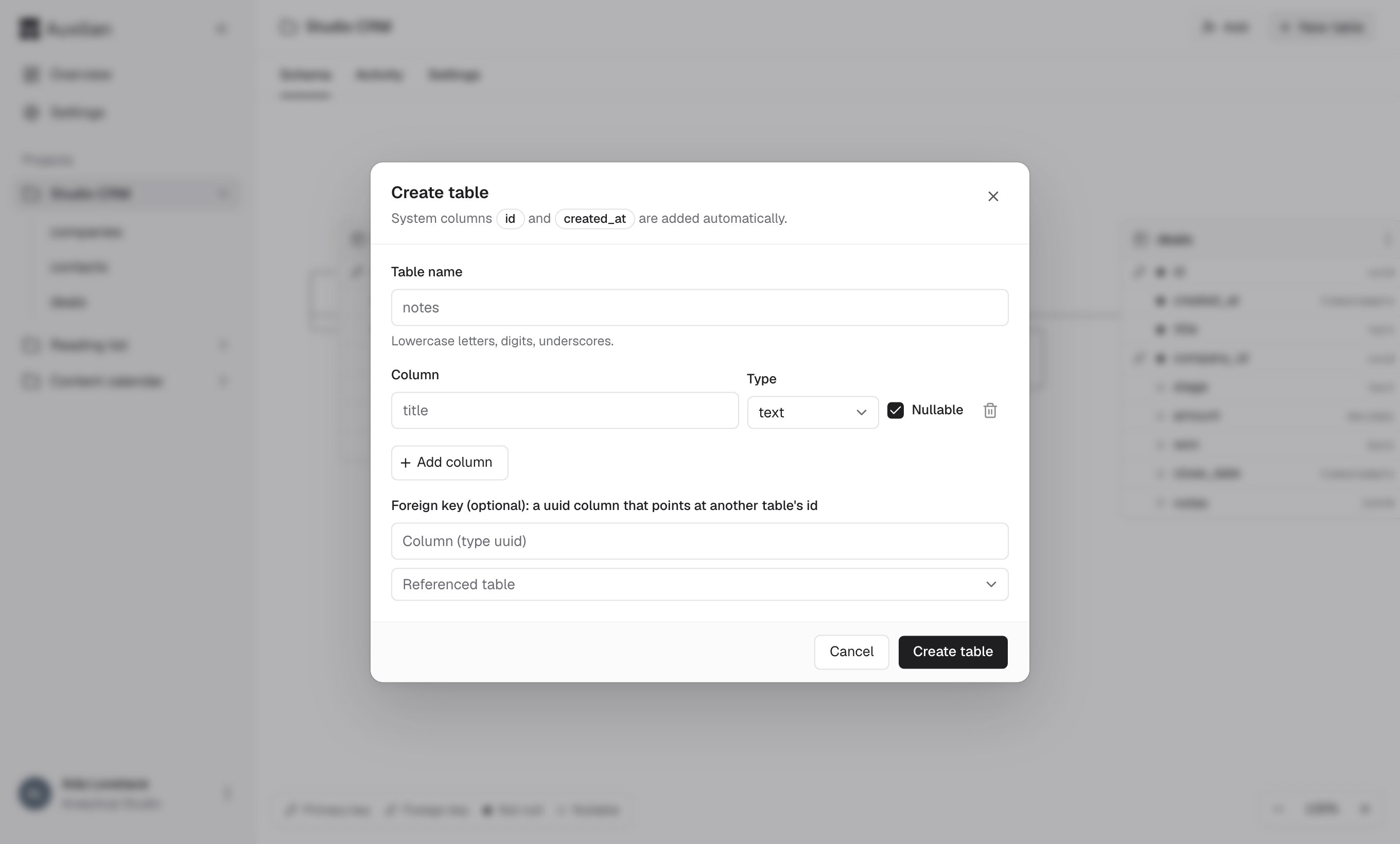
The Create table dialog.
Column types
See Data types for input and output formats.
Limits
- Up to 25 tables per project
- Up to 50 columns per table, not counting
idandcreated_at
Add a column
1
Open the table
Select the table in the sidebar.
2
Add the column
Select Add column, enter a name, choose a type, and set Nullable. Then select Add column in the dialog.
NULL in a new nullable column. A column that is not nullable can only be added to an empty table, because existing rows would have no value for it.
Foreign keys can only be defined when a table is created. To link an existing table, ask Claude to create a new table with the foreign key and move the data, or recreate the table.
Drop a column
1
Open table management
Open the table and select Manage.
2
Choose and confirm
Under Drop a column, choose the column, select Drop, then select Confirm drop.
id or created_at, and a table must keep at least one column of its own. To remove the last one, drop the table. If the column has a foreign key, the foreign key is removed with it.
Drop a table
1
Open table management
Open the table and select Manage.
2
Confirm the name
Under Drop this table, type the table name exactly.
3
Drop
Select Drop table. You return to the project’s schema.
Table "companies" is referenced by "contacts"."company_id"; drop that column or table first.
Rename or change a column
Auxilian doesn’t rename tables or columns, or change a column’s type, in place. To change one, add a new column, copy the values (Claude can do this withlist_rows and update_rows), then drop the old column.